
Exhibition Stand Manufacturer vs Supplier vs Contractor
Three companies quote you for the same stand. One calls itself an exhibition stand manufacturer, one an exhibition stand supplier, one a contractor. The renders look similar and the prices are within 20% of each other. The words are not interchangeable, though, and the difference decides who is actually holding a saw at 06:00 on build day — and who is forwarding your email to someone you have never spoken to.
This guide sets out what each term means in practice, what “turnkey” does and does not include, and the specific checks that tell you which one you are dealing with.
The Three Terms, Honestly Defined
Manufacturer
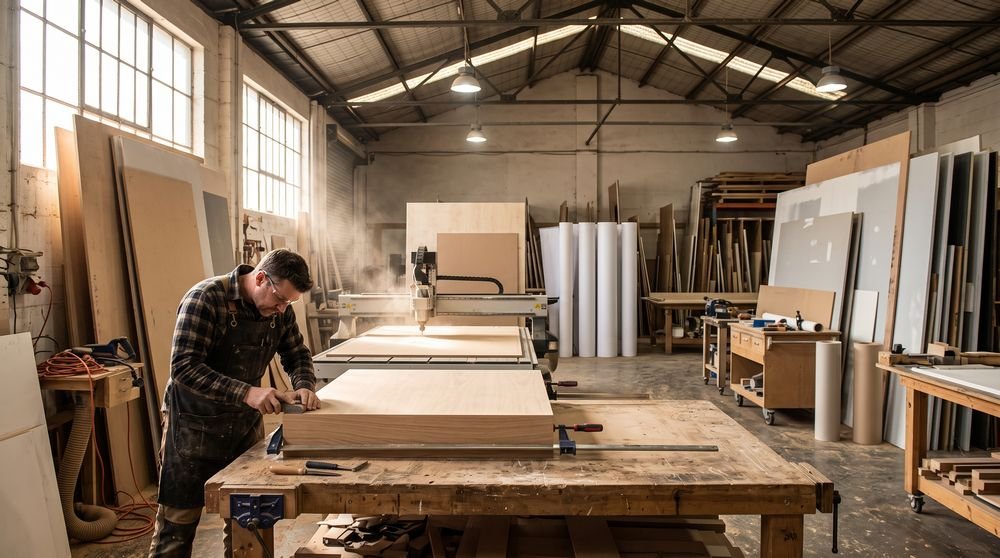
A company that owns production: a workshop, machinery, joiners, a print department, and a stock of system components. It makes the structure itself. When something is a millimetre out, it walks to the bench and fixes it. Most genuine manufacturers also design and install, because the three are hard to separate once you own the factory.
Supplier
A company that sources and sells stands, usually from a catalogue or a licensed system, and sometimes from a network of production partners. Good suppliers add real value — specification, buying power, logistics. But the physical build happens somewhere they do not control, and that gap is where schedule risk lives.
Contractor
The broadest term, and the one the industry uses most loosely. A contractor takes responsibility for delivering the stand to the hall. Some contractors manufacture; many subcontract the whole build and manage it. The word tells you about the contract, not about the workshop.
The overlap is real: Maverick is all three at once — we design, manufacture in our own workshops, and hold the contract. The point is not that one label is superior. It is that the label alone tells you nothing, so you have to ask a different set of questions.

What “Turnkey” Actually Covers
“Turnkey exhibition stands” is the most quoted and least defined phrase in the sector. A genuine turnkey scope should include:
- concept design, 3D visuals and buildable technical drawings;
- production of the structure, joinery, graphics and lit elements;
- organiser approvals, including a Standbaugenehmigung where the fair requires one;
- furniture, flooring, AV and lighting specification and hire;
- freight, delivery-slot booking and on-site handling;
- installation, supervision and a snag check before doors open;
- dismantling, return transport and storage between shows.
If any of those sit outside the quote, it is not turnkey — it is design-and-build with extras. Ask for the exclusions in writing. The detail of what each service level covers is in our guide to choosing an exhibition service package.
How to Tell a Manufacturer From a Reseller
Five questions separate them quickly:
- “Can I visit the workshop?” A manufacturer says yes and names a town. A reseller offers a showroom or changes the subject;
- “Who physically builds it, and are they your employees?” Ask for the company name of the build crew. “Our partners” is an answer in itself;
- “Will you pre-build my stand before it ships?” A workshop that owns the space and the crew can assemble your stand, check it and invite you to see it. This is the single most revealing question — see why the pre-build matters;
- “What is in stock right now?” Manufacturers carry system components and can tell you what they hold. Resellers order in;
- “Who signs the structural calculation?” For raised floors, towers and double-deckers someone qualified has to put their name on it. A manufacturer knows who that person is.
Why It Changes the Price — and the Risk
A manufacturer’s quote carries the factory overhead but no intermediary margin. A supplier’s carries the margin but not the overhead. On a single small stand the totals can land in the same place; the difference shows up in the things you only notice when they are missing.
- Change requests. In-house production absorbs a late change in days. A subcontracted build re-opens a commercial negotiation;
- Quality control. The firm that made the panel is the firm that inspects it;
- Show-day repair. A crew that built it can fix it. A crew that unpacked it often cannot;
- Reuse. A stand you will rebuild for years needs a manufacturer who holds the drawings, the spare components and the stand itself in storage.
On cost drivers generally, see the exhibition stand cost guide; on what a thin quote quietly removes, see the hidden cost of a cheap contractor.
When a Supplier Is the Right Choice
Being honest about this matters. A supplier or reseller is a sensible pick when:
- you need a small shell-scheme upgrade at a single show;
- you are buying a standard portable or pop-up system where the product is the product;
- you need something in under two weeks and the catalogue has it on the shelf;
- your budget genuinely will not carry a bespoke build this year.
What you should not do is pay manufacturer prices for a resold stand — which is exactly what happens when nobody asks the five questions above.
Where Maverick Sits
We manufacture in our own workshops, design in-house, and install with our own supervised crews across Germany, the wider EU, the UAE and Asia. Every stand is fully pre-built and checked before it ships, and every project has one named project manager from brief to storage. See what our building service includes, our work, or send us your brief for an itemised proposal.
Frequently Asked Questions
What is the difference between an exhibition stand manufacturer and a supplier?
A manufacturer owns the production — workshop, machinery and crew — and makes the structure itself. A supplier sources and sells stands built somewhere it does not control. Both can be good partners, but only one can fix a problem at the bench.
What does a turnkey exhibition stand include?
Design, technical drawings, production, organiser approvals, graphics, furniture, AV, logistics, installation, supervision, dismantling and storage. If any of those are excluded from the quote, it is not turnkey — ask for the exclusions in writing.
How can I check if a company really manufactures its own stands?
Ask to visit the workshop, ask whether the build crew are employees, ask whether they will pre-build your stand before it ships, ask what system components they hold in stock, and ask who signs the structural calculation.
Is an exhibition stand manufacturer more expensive than a supplier?
Not necessarily. A manufacturer carries factory overhead but no intermediary margin, so totals often land close. The difference appears in change requests, quality control, show-day repairs and whether the stand can be reused.
Do I need a manufacturer for a small stand?
Not always. For a shell-scheme upgrade, a standard portable system or a very short lead time, a supplier is often the sensible choice. For a bespoke build, a reusable asset or a stand at a strict fairground, own production is worth paying for.