Exhibition Graphics and Stand Printing: Specs, Options and Prices
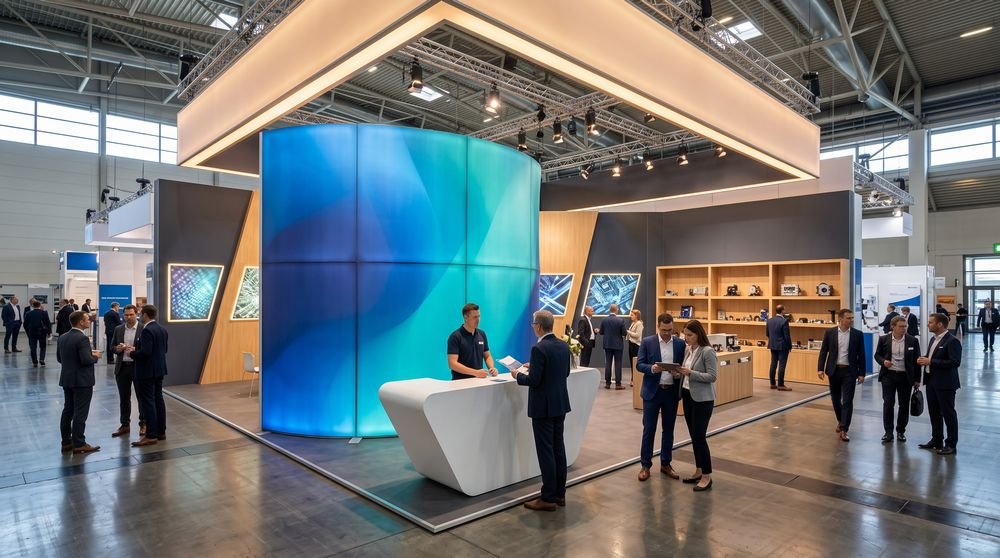
Exhibition graphics are the largest visual surface you control and usually the last thing anyone budgets properly. Print is ordered late, specified vaguely, and then blamed when a three-metre panel turns out soft or a colour drifts two shades from the brand guide.
This guide covers what you can actually order, what each format is good for, the artwork specs a printer needs from you, and what it costs. If you want help designing the artwork rather than buying it, read exhibition stand graphic design — this page is about procurement.
All figures below are indicative 2027 European trade ranges for planning only. Prices vary by substrate, quantity, finishing, city and lead time. ⟨CHECK all price ranges against Maverick’s current rate card before publishing⟩
The Formats, and What Each Is For
Tension fabric (silicone-edge graphics)
Printed stretch fabric held in an aluminium frame by a silicone strip. The default for modern stand walls: seamless at large sizes, light to ship, washable, and re-tensionable for the next show.
Best for: full wall runs, backlit lightboxes, curved surfaces. Watch: fabric can warp on a second tensioning if it was cut tight the first time.
Rigid board (direct-to-substrate)
Printed straight onto Forex, Dibond, foamboard or acrylic. Crisp, flat and rigid.
Best for: panels, signage, plinth wraps, product shelving backs. Watch: mostly single-use, heavy to freight, and the least sustainable option on this page.
Self-adhesive vinyl
Printed film applied to an existing surface — panels, floors, curved columns, glass.
Best for: floor graphics, shell-scheme panel wraps, window manifestation. Watch: surface preparation decides whether it lasts three days or lifts on day one.
Backlit film and lightboxes
Printed on translucent film and lit from behind. The single highest-impact print format there is.
Best for: feature walls, headers, product halos. Watch: artwork has to be prepared for transmitted light — files built for reflected light go muddy.
Roll-ups, pop-ups and banners
Self-contained portable units: roll-up banners, pop-up backdrops, flags, fabric towers.
Best for: conferences, sponsor slots, secondary stands, last-minute needs. Watch: they read as temporary next to a built stand — fine on their own, weak as the centrepiece.

What It Costs
Printed graphics
| Format | Typical 2027 range | Notes |
|---|---|---|
| Tension fabric graphic (frame excluded) | €45–90 per m² | seamless up to very large widths |
| Tension fabric, backlit grade | €70–130 per m² | pairs with an LED lightbox frame |
| Rigid board, direct print (3–5 mm) | €35–75 per m² | Forex / Dibond; price rises with thickness |
| Self-adhesive vinyl, walls | €30–60 per m² | add fitting labour |
| Floor vinyl, anti-slip laminated | €45–95 per m² | laminate is not optional on a floor |
| Backlit film for lightbox | €60–120 per m² | plus the lightbox frame |
| Fitting and installation labour | €45–75 per hour | per fitter, per venue rules |
⟨CHECK ranges⟩
Portable units
| Item | Typical 2027 range |
|---|---|
| Roll-up banner, 85 × 200 cm, premium base | €90–180 each |
| Fabric pop-up backdrop, 3 × 2.3 m | €450–900 |
| Flag / sail banner with base | €120–260 |
| Counter with printed wrap | €250–600 |
⟨CHECK ranges⟩
LED screens and AV hire
| Item | Typical 2027 range |
|---|---|
| LED wall hire, 2.6–3.9 mm pitch | €450–900 per m² for the show |
| Large-format screen hire, 55–86″ | €350–1,200 per show |
| Media player, content loading, on-site AV support | €300–800 per show |
⟨CHECK ranges⟩ Pitch matters more than size: a 3.9 mm panel viewed from two metres will look coarse, while 2.6 mm holds up close. Budget content production separately.
Furniture hire
| Item | Typical 2027 range |
|---|---|
| Stool / chair | €25–60 each per show |
| Poseur or meeting table | €60–140 each per show |
| Lockable storage cupboard | €120–280 per show |
| Bespoke branded reception counter (built, not hired) | €600–1,800 |
⟨CHECK ranges⟩ Most exhibitors should hire furniture and build only the reception counter — the reasoning is in exhibition stand furniture.
Artwork Specs Printers Actually Need
Getting these right removes most reprint costs:
- Vector (AI, EPS, PDF) for logos, type and shapes — it scales to any size cleanly;
- Raster at 100–150 dpi at final print size for photography viewed from a distance, higher for anything read close up. A logo pulled from a website will not survive enlargement;
- Colours as defined values — Pantone or CMYK, never “the blue from our site”. Expect a proof, and sign it;
- Fonts supplied or outlined, so nothing substitutes silently;
- Bleed and safe area to the printer’s template, because panels get trimmed and clamped;
- A panel map, not a flat artboard — graphics wrap corners, meet joins and run behind shelving.
The mistakes that cost the most are covered in exhibition stand graphic design.
Lead Times
- Artwork sign-off to printed panels: 7–12 working days is comfortable; 3–5 is a rush;
- Backlit and specialist finishing: add 2–4 days;
- LED and AV hire: book 4–6 weeks ahead for a major fair week, when local stock sells out;
- Rush print carries a premium and restricts substrate choice. ⟨CHECK lead times⟩
If your show is already close, see last-minute exhibition stands.
Buying Print Separately vs With the Stand
Ordering graphics from a general online printer is cheaper per square metre and frequently more expensive overall. A stand builder’s studio maps artwork to the exact panel dimensions, bleed and substrate of the structure being built, and carries the reprint if a panel is wrong. A separate printer prices the sheet, not the fit — and nobody owns the problem when the two do not match.
For anything beyond a roll-up, order the print with the stand.
Maverick produces stand graphics mapped to the build — flat panels, curves, backlit surfaces and floors — alongside LED, AV and furniture, as one turnkey service. Send us your artwork and plot for an itemised quote.
Frequently Asked Questions
How much do exhibition stand graphics cost?
As a 2027 guide, roughly €45–90 per m² for tension fabric, €35–75 per m² for direct-printed rigid board and €60–120 per m² for backlit film, plus fitting labour. ⟨CHECK⟩ Prices vary with substrate, quantity, finishing and lead time.
What resolution do exhibition graphics need?
Around 100–150 dpi at final print size for large panels viewed from a distance, and higher for anything read up close. Logos and type should always be supplied as vector files rather than images.
What is the best material for exhibition stand graphics?
Tension fabric for most wall runs — seamless at large sizes, light to ship and reusable. Rigid board for panels and plinths, self-adhesive vinyl for floors and existing surfaces, backlit film for feature walls.
How much does it cost to hire an LED screen for an exhibition?
As a 2027 guide, roughly €450–900 per m² for the show for a 2.6–3.9 mm pitch LED wall, or €350–1,200 per show for a large-format screen, plus media playback and on-site support. ⟨CHECK⟩ Book four to six weeks ahead in a major fair week.
Should I order exhibition graphics from a printer or my stand builder?
From the stand builder for anything beyond a roll-up. Their studio maps the artwork to the exact panels, bleed and substrate of your structure and carries the reprint if a panel is wrong — a general printer prices the sheet, not the fit.